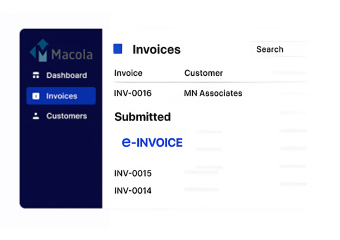
Macola Records Ready For Compliance
Mapping Macola Workflows Into Advintek
- Sales Extraction: Advintek receives eligible Macola sales information and identifies the transaction attributes needed for invoice creation.
- Commercial Enrichment: Customer, item, shipment, and tax information are combined to create a complete transaction record.
- Document Generation: The enriched record is transformed into structured electronic invoice content for the applicable Saudi Arabia workflow.
- Validation Gate: Required information is checked before the document advances, helping prevent incomplete records from continuing.
- Response Association: Processing responses remain connected to their original Macola transactions for easier investigation and accounting follow-up.
- Source Preservation: Original Macola references remain available alongside processed invoices, supporting stronger document lineage across business operations.
Where Advintek Adds Macola Value
Advintek works alongside Macola rather than replacing its manufacturing, distribution, inventory, purchasing, sales, and accounting processes, creating a dedicated connection between existing operational data and Saudi Arabia e-invoicing requirements.
- Converts completed Macola transactions into structured documents
- Carries fulfillment evidence into invoice records
- Preserves original Macola transaction references
- Connects operational data with ZATCA workflows
Macola Transaction Governance
- Customer Validation: Review customer information before invoice records are finalized for electronic processing and Saudi compliance requirements.
- Order Verification: Compare order details with generated documents to identify differences before submission and subsequent invoice processing.
- Shipment Matching: Relate dispatched goods to corresponding commercial records for stronger transaction consistency and accurate invoice preparation.
- Product Reconciliation: Compare item information across inventory and invoice records during operational review and financial reconciliation activities.
- Financial Matching: Associate invoice results with relevant accounting information for reconciliation activities and detailed transaction review.
- Exception Control: Isolate incomplete records so corrections can occur without losing transaction relationships or affecting downstream invoice processing.
Macola Data For Business Review
Order Billing Analysis
Examine how completed orders translate into invoice activity across customer transactions and billing records.
Fulfillment Comparison
Compare shipment information against invoice records to uncover differences between operational and billed quantities.
Account Activity Review
Review customer billing activity alongside transaction records to identify unresolved documentation requirements.
Macola Workflows Supporting Saudi Arabia Operations
Macola supports manufacturing and distribution organizations through connected processes covering inventory, purchasing, sales orders, accounting, and customer activity. Advintek adds the e-invoicing layer required to connect those operational records with Saudi Arabia workflows.
- Supports production-to-customer transaction continuity
- Connects distribution records with billing documents
- Relates inventory information to commercial activity
- Extends Macola processes into Saudi Arabia
Build a Stronger Accounting Workflow
Connect your Macola environment with Advintek for Saudi Arabia e-invoicing.
Create structured billing workflows around existing operations.
Ready e-Invoice System
Frequently Asked Questions Macola ERP E-Invoicing Saudi Arabia
What Macola records are useful before generating an e-invoice?
Customer, item, order, shipment, tax, and accounting information can provide important context for an invoice generated from Macola transactions. Advintek can use relevant source records to assemble the information required for electronic invoicing, while retaining references back to the originating Macola workflow. This reduces disconnected invoice preparation across manufacturing and distribution operations.
How does Macola distribution activity relate to electronic invoicing?
Macola is designed for manufacturing and distribution environments where sales orders, inventory, purchasing, customer activity, and accounting processes interact. Advintek can connect completed distribution transactions with invoice creation, carrying relevant order and fulfillment information into structured e-documents. This allows the invoicing process to remain connected with the operational activity recorded inside Macola.
Can production information be associated with invoices from Macola?
Production information can provide useful context when manufactured goods are subsequently sold and invoiced. Advintek can associate relevant Macola product and production references with the commercial transaction, where applicable, so the resulting invoice retains a relationship with the goods involved. This supports traceability between manufacturing activity, inventory records, customer orders, fulfillment, and electronic billing.
How can Macola inventory information assist invoice reconciliation?
Inventory records can help establish whether the products and quantities represented in billing correspond with underlying operational activity. Advintek can associate relevant inventory references with invoice transactions, giving teams additional context during reconciliation. This is particularly useful when reviewing differences between sales orders, dispatched products, warehouse activity, and the information ultimately represented in electronic invoice documentation.
What happens to the original Macola transaction after invoicing?
The originating Macola transaction can remain associated with the resulting invoice information through the integration workflow. Advintek is designed to preserve source references while processing electronic invoice data, giving users a traceable connection between operational records and generated documents. This helps teams investigate exceptions, reconcile accounting information, and review transaction history without separating invoices from their source processes.